

“Villa are a big, big part of my life – they are my family”
Stan Petrov admits a real feeling of community pervaded the dressing room between 2008 and 2010 – during undoubtedly his best Villa years.
But he says that claret and blue spirit also inspired him in his darkest days, when he fought for his life following his diagnosis with leukaemia in 2012.
Petrov insists he will never forget the support he received from Villa players, staff and fans as he battled bravely against the destructive disease.
“Villa was important to me when I was playing football – and even more when I was going through the hard times after I retired,” he said.
“Villa are a big, big part of my life – they are my family.
“When you see a club sticking with you – things like the 19th minute applause – it’s just incredible.
“The club and the fans are still right behind me now.
“I will never let that feeling of family go. It’s a feeling that is impossible, really, to express fully.
“It’s a feeling I wish everyone had when they had difficult times to face.
“To have the Villa family with me during those times was simply incredible.”
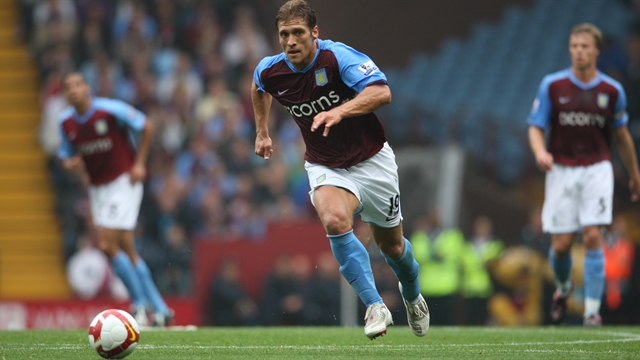
The seasons 2008-09 and 2009-10 were some of Petrov’s most accomplished on the football field.
In the first of these, Villa boasted one of their most potent and powerful teams in recent memory, with the likes of Martin Laursen, Brad Friedel, John Carew, Gareth Barry and Gabby Agbonlahor in top form.
It was a case of ‘so near, yet so far’ as they scaled the heights – reaching third in the Barclays Premier League at one point – but ultimately Petrov said the emotion was one of “immense disappointment” as O’Neill’s men failed in their bid for the Champions League.
“We had a very strong team that season – as footballers and personalities,” he continued. “It can be very difficult to build a top team but we managed to do it.
“We were looking forward to making the top four – we believed we could do it.
“We were several points ahead of Arsenal at one stage and feeling confident.
“At the end of the season, I remember finishing sixth and we all looked at each other and wondered how that had happened.
“It just went wrong for us. We knew how much quality we had but we just couldn’t grab it.
“To finish sixth was good – but in our eyes it was a very disappointing season.”
The season also saw the despondency of skipper Laursen’s retirement from football – and Petrov was the man chosen to step into the Dane’s shoes and wear the armband.
It was a moment of immense pride for Petrov to be named skipper.
“Being a captain is a big responsibility. When I came here, Gareth Barry was the captain. He led the team by example. I always looked up to him.
“As skipper you are the role model for everyone else – on and off the pitch.
“When I was given the captaincy, I knew the responsibility it entailed and what was expected of me. It was a massive moment for me to receive the armband.
“Anyone can have a bad game but as captain, you have to be a good team-mate, even if you don’t play well.
“You have to come off the pitch with your head held high. You come off sometimes and think ‘I personally wasn’t good enough but I helped the other lads out and was a good captain.’ That’s the way I was thinking.”
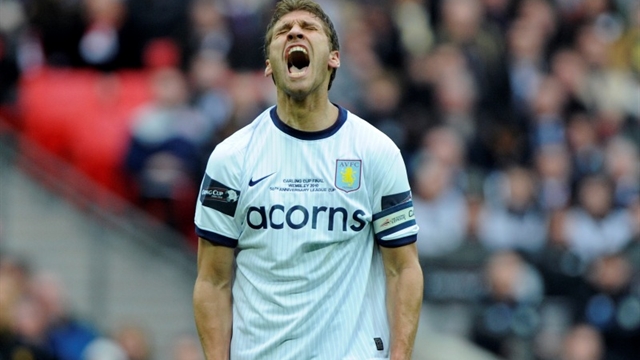
The enormity of being skipper really hit home to Petrov when he led Villa out at Wembley for the League Cup final in 2010.
Petrov looks back with pride at that moment in his career – but ultimately, as a fierce football competitor, he also still feels the upset of defeat – and in controversial circumstances.
“We were very close that day. We had the situation that everyone remembers – Gabby Agbonlahor being brought down by Nemanja Vidic in the early moments of the match.
“He was going through on goal and on another day they would have gone down to 10 men.
“We ended up losing 2-1, 11 v 11, but even then we had plenty of chances to win it. It didn’t go for us. It was very disappointing.
“With the team we had, going up against them with 10 men and 1-0 up, I think we had a big, massive chance to win the cup.
“We feel like the referee didn’t make the right call. We went back to the dressing room and in the back of my mind I thought ‘that could have been so, so different.’
“Unfortunately these things happen and, as I always say, people always remember the winners, not the ones that lose.
“We were back, soon after, for the semi-final of the FA Cup against Chelsea. That was completely different. We were in the game until we found ourselves 3-0 down very quickly.
“But playing at Wembley in the Villa shirt was a proud moment for every player in the team.”
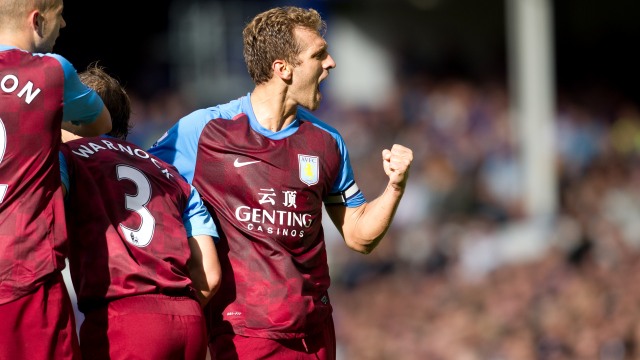
Petrov then found life tough under Gerard Houllier before being handed a new lease of life by Alex McLeish, who – having known him from their time together in Scotland – reinstated him to his attacking cavalier role in the team.
“I felt good about my form under Gerard – I started very well.
“We beat Man City and then I went away for the international break. I remember I came back and I was given the explanation that I was being rested. But I was out for weeks and weeks!
“I couldn’t do anything but as skipper I was still a good captain and did my work as diligently as ever.
“When the team was in some problems – in the relegation zone – I was brought back into the team for the game against Newcastle and we won 1-0.
“Then we won four of the final seven games – beating the likes of Arsenal, Liverpool and West Ham. We managed to stay up quite comfortably in the end. It was a good feeling to be back and help the team.
“I know that’s the way football goes sometimes.
“Alex gave me more opportunities. He knew me from my time at Celtic. He was at Rangers, of course. He knew what I could do.
“He gave me the licence to go forward more. I started scoring goals again. I was back to my previous role as an attacking midfielder – creating chances and scoring goals.”
Soon after, playing football became an irrelevance as he fought a violent bodily foe.
It was an alarming altercation but he won – and we’re all relieved he did.

 Paul Brown