
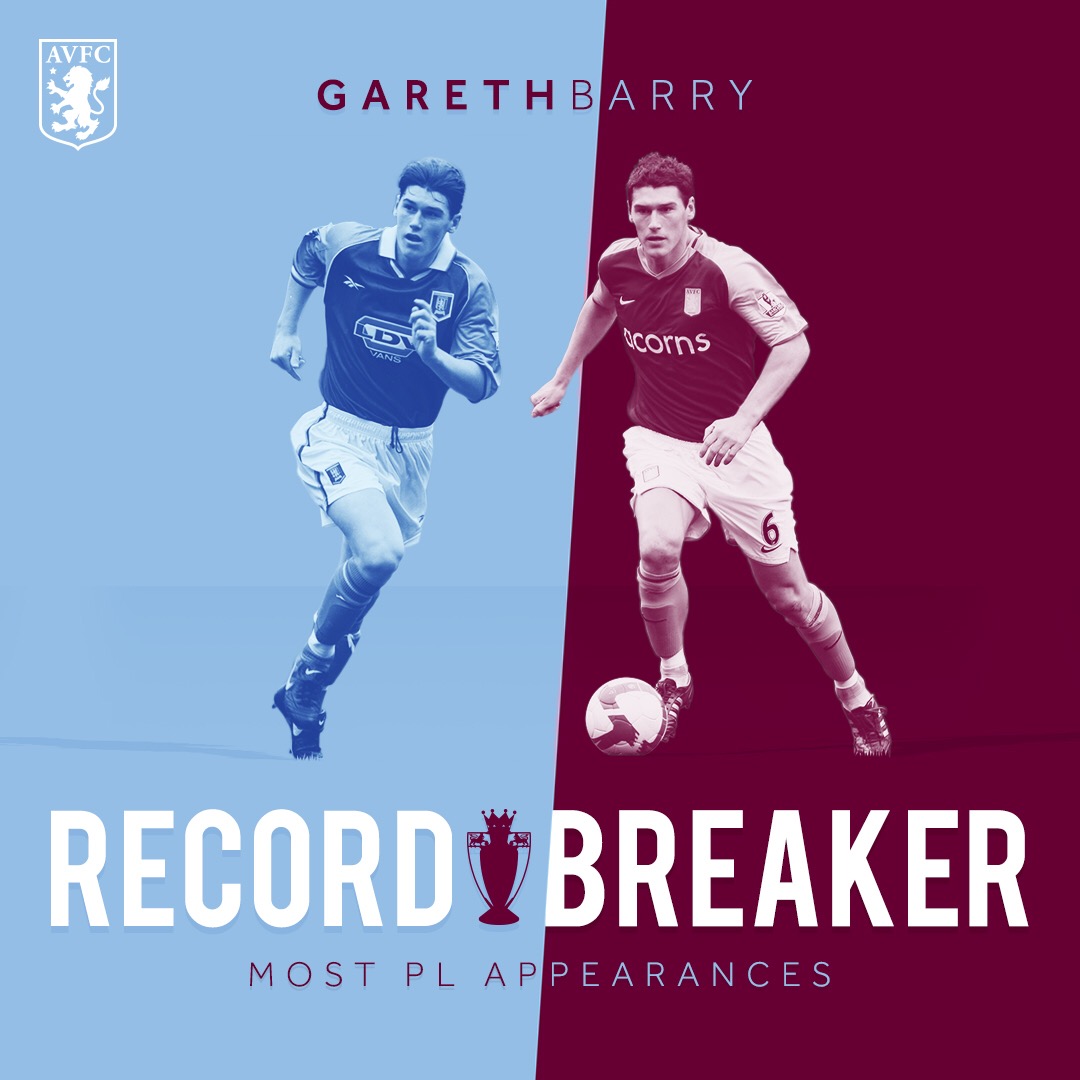
Gareth Barry became a record breaker as he took the crown as the all-time appearance maker in the history of the Premier League.
Barry made it to 653, eclipsing Ryan Giggs in the process and earning praise from football icons like Arsene Wenger, Ronald Koeman and Pep Guardiola.
He made 365 of those appearances for Aston Villa before a big-money move to Man City.
That led to vitriol from the claret and blue faithful as they felt betrayed by one of their favourite sons.
Looking back now, Barry should take this as a compliment.
His departure was, more than anything, a sign of their love for him – and his importance to an improving team under the leadership of Martin O’Neill.
Even when the furore was at its height, Barry wrote a heartfelt letter to the fans thanking them for their support and explaining his decision – something he could easily have skipped.
The decision summed up the man – and his ever-professional approach.
Time has passed since then and supporters, previously furious, took to social media to congratulate Barry when he broke the top-flight record two years ago.
Now that the mood has calmed, it’s time to ask a most important of questions…is GB the club’s modern-day ‘GOAT?’
Just prior to his departure in 2009, he was ranked No.12 in the post-war best-ever list, a poll topped by Gordon Cowans.
Also in front of GB were the likes of Paul McGrath, Dennis Mortimer, Peter McParland and Peter Withe while he found himself ahead of other heroes such as Dwight Yorke, Brian Little, Olof Mellberg and David Platt.
In my time following the club, Barry has been the standout by a distance.
I admired Mellberg greatly for his classy consistency but, in my opinion, Barry was a cut above.
The biggest compliment you can pay is that he could play in any position and excel – and he did a lot of that in claret and blue.
Barry grew up, in a football sense, as a schoolboy with Brighton & Hove Albion but in 1997 he decided to join our Academy.
It was a decision which ultimately cost the club £1m in compensation but the outlay ultimately looked no more than small change.
He signed professional on turning 17 in February 1998 – and at the end of that season had his first taste of senior football, going on as a substitute for the injured Ian Taylor in a 3-1 win at Hillsborough.
He played that day in midfield – the position where he would make his biggest impact in claret and blue.
Yet his early days were mainly spent as a central defender before moves to left back, left midfield and eventually the heart of the pitch under Martin O’Neill.
Wherever he played, he was always at least an eight out of ten man for us – and displayed tenacity, determination, heart, passion and a range of passing unsurpassed by few…if any.
Mortimer won more. McGrath was more newsworthy. Yorke had more charisma. Cowans was more enduring. But was Barry No.1? That’s the ultimate question.


